Source Layers
Every message starts with a head like main.py:10. By default that head points
at the line that called np.show. The p mark moves the head up the call
stack, so a shared logging helper can report the place that used it.
The stack
p0 is the frame of the np.show call itself, p1 is its caller, p2 its
caller’s caller, and so on. Bare :p is :p1.
import neoprint as np               # ln1
def aaa():                          # ln2
    def bbb():                      # ln3
        def ccc():                  # ln4
            np.show('DDD', ':p0')   # ln5 -> ln5
            np.show('CCC', ':p1')   # ln6 -> ln9
            np.show('BBB', ':p2')   # ln7 -> ln10
            np.show('AAA', ':p3')   # ln8 -> ln11
        ccc()                       # ln9
    bbb()                           # ln10
aaa()                               # ln11
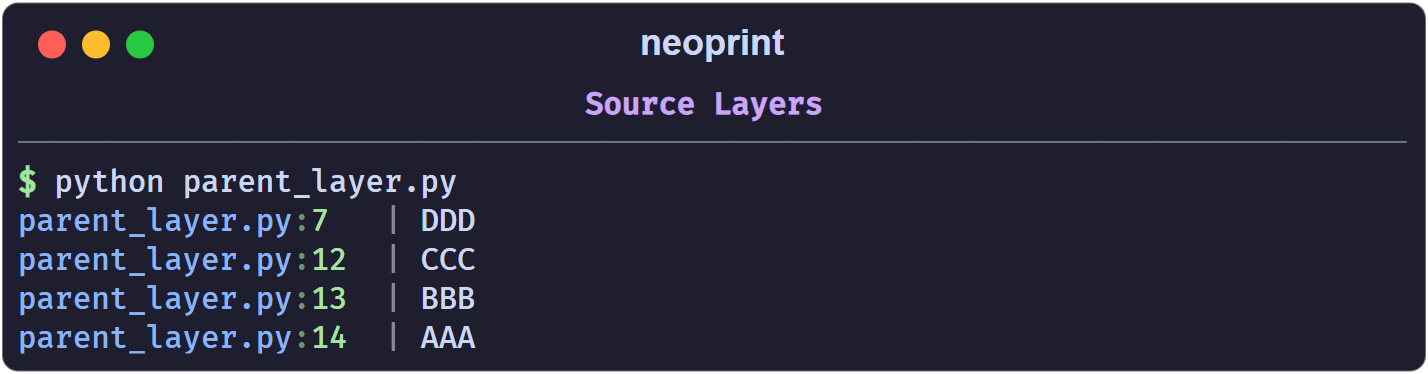
p0 reports the line that printed; p1 reports the line that called that
function; and so on. Going further than the stack depth raises an error, so
the practical range is p0 to p3.
Why it matters
Consider a library method that is called from many places. With :p, each
message points at the caller, not at the library:
import neoprint as np

class Library:
    def borrow_book(self, book_name):
        np.show('borrowed "{}"'.format(book_name), ':p')
        return Book(book_name)

lib = Library()

# in aaa.py
lib.borrow_book('Stray Birds')

# in bbb.py
lib.borrow_book('How the Steel Was Tempered')
aaa.py:8    | borrowed "Stray Birds"
bbb.py:10   | borrowed "How the Steel Was Tempered"
That is how you trace which script triggered a shared code path.
Temporarily elevate stack pointer
Use np.elevate_parent_level to redirect :p<n> to n+1 place:
import neoprint as np
from random import choice

def source_test():
    if choice((True, False)):
        print('Server is working fine', ':pv4')
    else:
        print('Server is unavailable for now', ':pv8')

def proxy_test():
    with np.elevate_parent_level():
        source_test()

# by client a
source_test()

...

# by client b
proxy_test()
The proxy hides itself and reveals print header points to the position of client b.
Relationship with varnames
:p only moves the head (the source prefix). Variable names from :n are
always read from the line where np.show is written, regardless of :p. In a
shared helper, the values passed to the helper still come from the helper’s own
line, while the head shows the outside caller.
Note that p2 and above rely on the interpreter’s stack being intact. Inside
heavy wrappers or asynchronous code, prefer :p1.